

Reading time 5 min
How to Turn Water Back On after a Disconnect
An unexpected shut-off puts the whole household off cycle. Mornings go awkwardly with no water, appliances stall, and the first question in everyone’s mind is always the same: how can the water be turned back on in time and in a safe manner. We see this happen quite often and realize that the key to resolving this issue quickly is in finding the reason behind the shut-off. This is what American Choice Plumbing tries to address.
Common Reasons Why Water Gets Disconnected
Interruptions arrive in a few recognizable patterns, each carrying practical implications for repair and restoration. The most straightforward cause is having the water disconnected for non-payment of utility bills. Utilities follow paperwork and notice cycles, sending an initial late notice and then a final disconnection warning, typically over a 30 to 60 day window before shutting service off. Once the water service is disconnected, reconnection fees are standard and commonly fall between $25 to $150, with higher charges possible for after-hours work.
Planned work on the distribution network is the reason behind many brief power interruptions. Utilities have scheduled work such as the replacement of meters and pipeline upgrades and usually inform consumers about this 24 to 72 hours in advance through mail or announcements. Such disruptions usually last for several hours but may be longer if the work is complex.
Emergency shutoffs happen when a main breaks, a contamination alert such as E. coli detection arises, or a sudden severe pressure loss occurs. The utility will act immediately and whole neighborhoods can be affected, leaving residents with no running water until the situation is resolved. Restoration time depends on how complex the repair or the safety remediation is.
Finally, on the other hand, on the private side, a homeowner or a plumber might turn off the main water shut-off valve at the property in order to terminate a serious leak, replace a water heater, a toilet, or during a large renovation.
Seasonal or vacancy shutdowns occur when the weather is cold to prevent pipes from freezing. Another method is to drain a system when a house is to be vacant for an extended period.
Meter and service line tampering will result in immediate disconnection and legal action. Also, there are detection mechanisms employed by utilities companies. Lastly, failure to abide by water use guidelines during droughts can result in disconnection of services.
Who Controls Your Water Supply?
Responsibility for water divides along familiar lines, and knowing where those lines fall clarifies what you can and cannot do. In most cities and suburbs the supply comes from Municipal Water Departments or Public Utilities. Those agencies handle treatment, distribution mains, billing, and maintenance up to the meter. They often own the infrastructure to the property boundary and are charged with maintaining water quality and continuity of supply, including instances when water is shut off by the city for necessary maintenance or emergency repairs.
In certain areas, they depend on the Private Water Companies. These are for-profit firms like American Water and California Water Service Group. Their structure of ownership varies from that of a municipal utility and are governed either by the state or the city, while they do the same functions.
In planned developments, an HOA might be managing a small distribution system, purchasing bulk water or doing small-scale treatment for a community. Out in the countryside of America, approximately 13 million households have their water from "Private Well Systems." All of these owners are responsible for their well, pump, pressure tank, filters, and water tests.
What it boils down to in practical terms is that the distinction between what constitutes utility property and what constitutes property owned by the other is easy to make in the sense that the utility maintains control of the master supply line up to the water meter or property boundary. The property owner maintains control beyond that point.
Check If the Water Shutoff Is Inside or Outside Your Home
Finding the correct shutoff matters. There are typically two control points that behave very differently. The main shutoff inside the house is the owner’s primary control, ensuring the water is turned off at the house effectively during emergencies. Located where the service line enters the structure, it is often in a basement along the front wall, inside a utility closet, in a garage, within a crawl space, or near the water heater. In warm climates it might be on an exterior wall. The valve will be either a gate valve with a round wheel requiring several turns, or it will be a ball valve with a lever requiring only a quarter turn to open. Ball valves will be more evident in new buildings as they are easy to operate.
The curb stop or street shutoff is usually located outside and is normally the property of the utility company. Being located near the street or sidewalk and within the property line, it can usually be found in a meter box with a metal or plastic cover. The operation of the curb stop requires a specific tool in the form of a curb key or water meter key, as it can be below ground. The curb stop can be utilized by the utilities for purposes of reading the meter, carrying out scheduled work, or turning services off. Homeowners are warned against using it, except with permission from the company.
The water meter itself is usually close to the curb stop or just inside where the main enters the house; it serves as a vital tool for leak detection and may have dedicated shutoffs on either side. The service main is typically a larger pipe, often 3/4 inch to 1 inch in diameter, and is distinct from the narrower lines that feed fixtures throughout the home.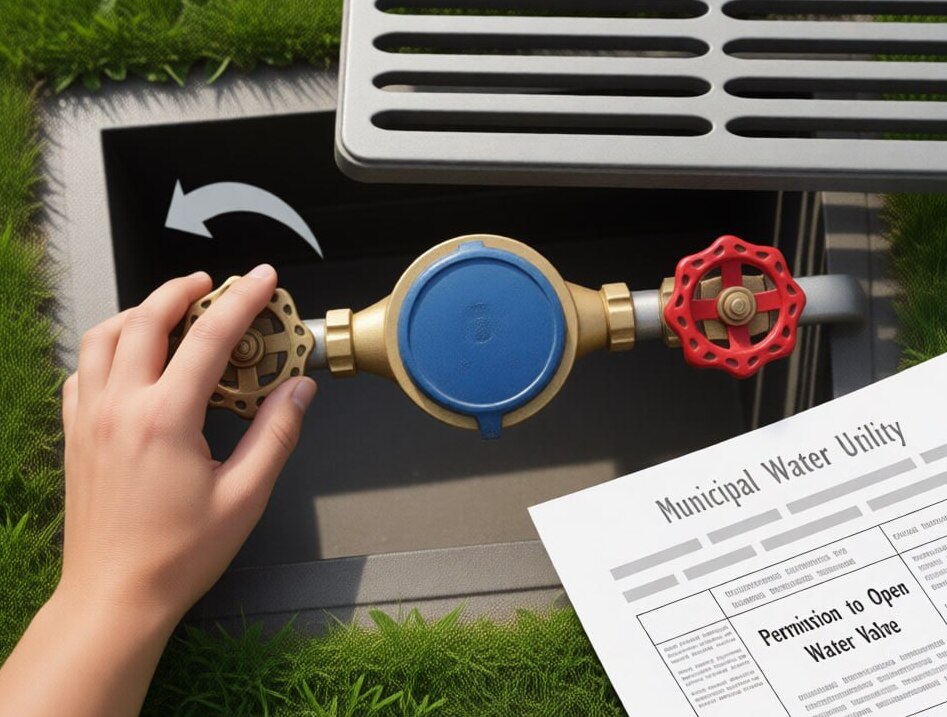
How to Turn Water Back On After a City Disconnect
When the city has cut service, understanding how to turn the water back on after a disconnect involves an administrative and practical sequence. First, settle the reason for the shut-off, then confirm reconnection with the utility. Finally, prepare the plumbing system for pressure reintroduction.
Follow these steps to restore service after a city disconnect:
- Confirm the cause and pay any outstanding balances and reconnection fees as required by the utility.
- Contact the utility to schedule the reconnection and to verify any required repairs or inspections have been completed.
- Close all indoor and outdoor faucets and disconnect appliances such as washing machines, dishwashers, and water heaters.
- Have an adult present if the utility requires access to the curb stop or meter box for reconnection.
- After the utility restores service at the curb, open the interior main shutoff slowly.
- Bleed air from the system starting at the lowest cold-water faucet and work upward, then repeat the process for hot water once the heater refills.
A gradual approach prevents pressure shocks that can stress pipes or fixtures. Open the main slowly and listen for unusual sounds. Banging pipes or persistent sputtering can indicate trapped air or pressure irregularities. Inspect visible fittings for leaks and watch water clarity. Any initial water discoloration from disturbed sediment should clear quickly. If water does not return as expected, contact the utility or a professional plumbing service for further help.
How to Restore Water After a Temporary Shutoff
When the shutoff was done on purpose, the procedure to restore water service is more about careful sequencing than paperwork. Make sure repairs or installations are finished and tightened. Confirm every faucet and valve is closed, including appliance shutoffs and outdoor hose bibs. If you drained the water heater, verify its drain valve is closed.
Open the main shutoff inside the house slowly. Whether it is a gate valve that needs several turns or a ball valve moved to the open position, the goal is to repressurize gently, which serves as a functional pressure testing of the system's integrity. Fast-starting systems can develop pressure shocks, which can strain joints and connections. After the main is switched on, bleed air out of the plumbing system. Beginning with the lowest cold-water faucet, turn it on and allow it to run until bubbling ceases. Close the faucet and work higher, then follow the same process for hot water so that the water heater is replenished prior to being energized, rather than turning on an empty heater, which can cause extensive damage.
Once the water comes back on, inspect the work areas, take a look at the main turn-off valve, and check the replaced fixtures for leaks. Listen for unusual noises in the pipes that could indicate the air is still being blown out. A brief discoloration of the water is perfectly normal after the disruption in the system and should resolve itself shortly. If the pressure is irregular or the discoloring persists, have a professional plumber take a look before a small issue escalates.
What to Do If Water Still Won’t Turn Back On
When the usual steps have not worked, a few specific causes are most likely. If you have followed the standard procedure for how to turn the water back on but still face issues, first confirm the interior main shutoff is fully open. Valves sometimes sit partly open and limit flow without an obvious visual clue. If the city performed the disconnection, check with them that the curb stop is opened again. Attempting to operate the curb stop on your own is risky and should be avoided unless a utility representative explicitly directs you.
Airlocks may need to be purged from the system before the water flows again. One method of doing that involves attaching a hose between an outdoor water spigot and an interior faucet and turning both slowly to push the water out of the hose and then the pipes to the highest faucets that have pulsating water flow before all that’s left is steady water. Other shut-offs may be located near sinks with toilets to ensure that the water to the home isn’t really turned off even if it seems that way due to a single shut-off that’s been closed.
Check the water meter for any signs. If the meter is presently turning when there is no water being used, then there is a hidden leak. If there is no movement when the main is turned on inside, then there is no flow at all through the meter, and this presents a problem at or prior to the meter. Low pressure versus no water can be an important distinction. Low pressure means there may be a valve not all the way on, or a failing pressure regulator.
If you have exhausted all the options and might have had issues like frozen and split pipes, a problematic PRV, and issues with the buried leak, the best course of action at this point would be to call a professional plumber. They are able to help you identify hidden shut-offs and issues with the pressure regulators and leakages. Reconnection might have been reaffirmed by the utility company if there are issues to report to them again with the information such as address and the options pursued so far.